Recycling Contamination: What It Is and How Cities Reduce It
By Dennis Barrett, President, Roadway Displays · Published October 2026
Recycling contamination is anything in a recycling cart that the program does not accept, or accepted material too dirty to sort. A greasy pizza box, a bag of bottles tied shut, a garden hose, a battery: each one lowers the value of the load and slows the people and machines sorting it. Cities reduce recycling contamination the same way they change any habit at the curb. They tell residents exactly what goes in the cart, they show it where the cart is, and they keep repeating it.
This guide is for the recycling coordinators, solid-waste staff and fleet managers who run that work.
What counts as recycling contamination?
Contamination is any item that does not belong in the cart under your program's rules, plus accepted items that arrive too soiled to recycle. Because every program accepts a different list, the same yogurt cup can be clean recycling in one city and contamination in the next.
Most programs sort contamination into two kinds. The first is the wrong item: plastic bags and film, hoses and cords, clothing, foam, batteries, propane cylinders, diapers and yard waste. The second is the right item in the wrong condition: a jar half full of salsa, a box soaked through with grease, recyclables sealed inside a trash bag so the sorters cannot get to them.
Much of it comes from good intentions. A resident who is unsure puts the item in the blue cart and hopes it gets recycled somewhere down the line, which the industry calls wishcycling.
Why is recycling contamination a problem?
Contamination costs a program twice: once to pull the wrong material out, and again when buyers pay less for bales that are not clean. It also puts workers and equipment at risk, because some contaminants jam machinery and others start fires.
For a city, the cost shows up where residents never look. Clean paper gets spoiled by food and liquid, material that should have earned revenue gets landfilled, and the hauling and disposal still have to be paid for.
For scale, EPA's national figures for 2018 put the U.S. recycling and composting rate at 32.1 percent of municipal solid waste (EPA national overview).
What happens to a contaminated recycling load?
A load with some contamination usually still goes to the sorting facility, where people and machines pull out what they can and the rest goes to landfill. A load that is badly contaminated can be rejected outright and sent to disposal, which means the residents who sorted carefully on that route lose their work too.
What happens next depends on your own agreements and collection rules. Some programs respond at the curb with a tag or notice on the cart, and some skip a cart that is plainly wrong until the resident fixes it.
In California, the SB 1383 regulations spell out part of that response. A jurisdiction with three- or two-container organic waste collection must monitor its containers for prohibited contaminants, either by reviewing every hauler route each year or by running waste evaluations at least twice a year. On a route review, a household or business found with contaminants gets a notice explaining how to separate materials properly (14 CCR § 18984.5).
Which items cause the most trouble?
Plastic bags and film, food and liquid, tanglers like hoses and cords, and batteries are the items most programs single out. The first three slow or spoil sorting; batteries can spark fires in a truck hopper or at the facility.
| Contaminant | Why it causes trouble | What the resident should do instead |
|---|---|---|
| Plastic bags and film | Wraps around sorting equipment; hides what is inside | Put recyclables in the cart loose; follow your program's rule for bags |
| Food and liquid | Soaks and spoils paper and cardboard | Empty and give a quick rinse; trash the greasy part of the box |
| Hoses, cords, string lights | Tangle around equipment | Trash, or a drop-off your program names |
| Batteries and propane cylinders | Can spark fires in trucks and facilities | Household hazardous waste or a drop-off your program names |
| Bagged recyclables | Sorters cannot open the bag, so it is often discarded | Cart the items loose |
Use your own program's list when you put this in front of residents.
How do cities reduce recycling contamination?
Cities reduce recycling contamination by keeping the rules short, showing them where the cart is, giving residents feedback and repeating the message for as long as the program runs. A single mailer explains the rules once; residents learn them by seeing the same few rules again and again where they make the decision.
The programs that do this well tend to share a few habits:
- A short, specific list. "Empty, clean, loose" and the three or four items your facility fights most often. Residents can hold a handful of rules in their heads.
- Pictures over words. An image of a plastic bag with a line through it needs no translation, and it is readable from across a street.
- Feedback at the curb. Cart tags and route checks tell one household what went wrong, on the day it happened.
- The languages your residents speak. A message only works when the reader can read it.
- A message that changes with the season. Holiday boxes in December, yard waste in spring and fall. A rule that matters this month is easier to notice than one that has sat on the same sign for years.
- A way to check. Route audits and the facility's own reports show whether a campaign moved anything, and which item to target next.
California writes the language point into its rules: jurisdictions must translate SB 1383 education materials into any non-English language spoken by a substantial number of the residents they serve (14 CCR § 18985.1(e)).
What does a contamination education budget buy?
A contamination budget usually buys some mix of mailers and bill inserts, cart tags and stickers, web and social posts, route checks, and outdoor signs. The best split depends on where your residents actually make the decision, which for recycling is at the cart on collection day.
Each channel does a different job. A mailer or bill insert carries the full list but is read once, if at all; cart tags reach the household getting it wrong; signs reach everyone who passes, every week, with nothing to open.
The question of where the message goes is an old one in this work. Dennis Barrett, who designed the first frames with his father Bob in 1987, describes what cities had to work with back then: "cities and municipalities did not know how to promote and educate the public on recycling especially with new State mandates. The only mediums they had were TV, newspaper, billboard, or mail inserts into the Bill." Today the collection fleet is one more place to put that message, and the trucks are already paid for and already on every route.
Why put the contamination message on the collection truck?
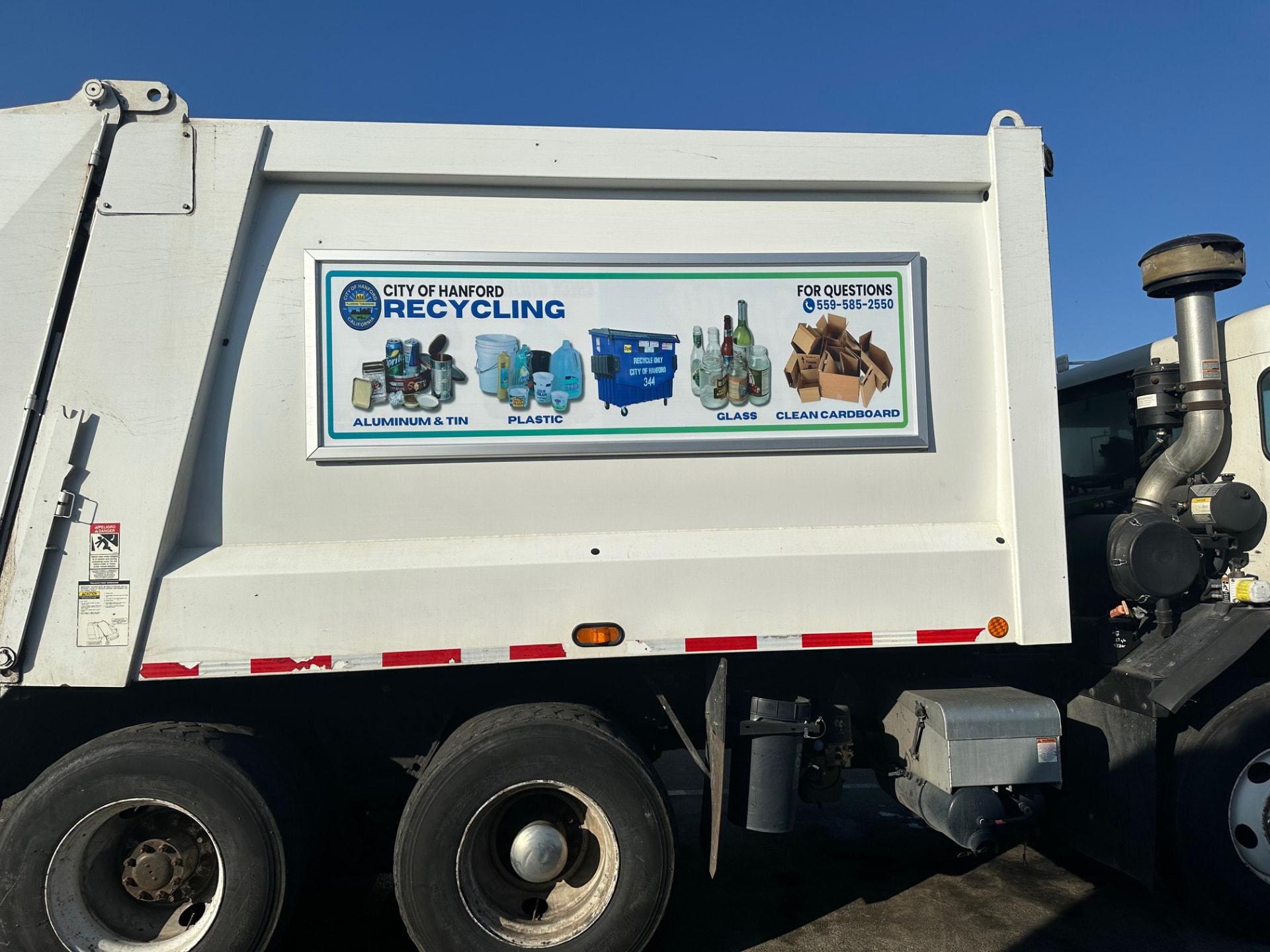
The collection truck is the one part of a recycling program every household sees on collection day, on its own street, next to its own cart. A contamination reminder on the side of that truck reaches residents at the moment and in the place the rule applies.
A contamination message also has to change with the season and with whatever the facility is fighting that quarter. Roadway's Quick-Change Frame System solves that with hardware: an aluminum frame riveted to the truck once, holding a printed campaign panel by spring tension on all four sides. An authorized member of your own crew changes the panel at the yard in under 30 seconds. "Bags out, loose in" can run this month and "Clean, empty, dry" the next, on the same trucks.
For a program running a contamination campaign this way:
- No minimum order. A city can equip one truck to test a message on one route and add trucks later.
- Free design with unlimited proof rounds, built to be read from a moving vehicle.
- Panels ship five to seven business days after proof approval, and a rush moves to the front of the line at no extra charge.
- The frame is warranted indefinitely against mechanical failure. Damage from trees, buildings and driving is excluded.
San Diego, Roadway's first customer, still runs the frames, and Burbank, Los Angeles (LA Sanitation), Sacramento, Long Beach, Pomona and Hanford have put Roadway panels into service on their collection trucks. Read how cities plan a year of campaigns on the same fleet.
Dennis describes what he hopes the frames carry: "the same type of passion that the Recycling Coordinators of the cities have towards recycling and saving the planet."
If you are planning a contamination campaign and want the fleet in it, Get Budgetary Pricing Tell us your truck count, body types and the first message, and we will send figures your department can use for planning and grant applications, with a no-charge mockup of your own trucks wearing the artwork.
Frequently asked questions
What is contamination in recycling?
Contamination is any item in the recycling cart that your program does not accept, or accepted material too dirty to sort, such as a food-soaked box. It lowers the value of the load and can send good material to landfill.
What happens if I put the wrong stuff in my recycling bin?
At the facility, workers and machines pull out what they can and the rest is landfilled. Heavy contamination can get a whole load rejected, and some programs tag or skip a cart that is plainly wrong until the resident fixes it.
What are 5 things that cannot be recycled in most curbside programs?
Plastic bags and film, garden hoses and cords, batteries, propane cylinders, and food-soiled paper are on the do-not-recycle list in many programs. Lists vary by city, so residents should always check their own program's rules.
Is wishcycling a problem?
Yes. Putting an item in the cart in the hope it can be recycled adds contamination, and the safest rule for residents is "when in doubt, leave it out" unless your program says otherwise.
How often should a city change its contamination message?
Often enough that residents still notice it. Many programs time messages to the season, such as holiday boxes in December and yard waste in spring, and change focus when route checks or facility reports show a new problem item.
Can a private hauler run contamination messaging on its trucks?
Yes. A hauler whose city contract includes public education can carry the contamination message on its own vehicles with the same frames; see frames for private haulers.
About the author. Dennis Barrett is President of Roadway Displays. He built the first frames with his father Bob in 1987, has worked at Roadway full time since June 2000, and runs manufacturing and printing in Temecula, California.