Recycling Education Campaigns: How Cities Plan One That Residents Remember
By Dennis Barrett, President, Roadway Displays · Published October 2026
Recycling education is the work a city does to tell residents what goes in each cart, why it matters, and what changed this season. A campaign is that work with a start date, one message and a plan for where residents will see it. The cities that get results keep the message short, put it where residents make the sorting decision, and repeat it long after the launch.
This guide is for the recycling coordinators and solid-waste staff who plan that outreach.
What is a recycling education campaign?
A recycling education campaign is a planned stretch of public outreach aimed at one change in how residents sort, set out or reduce their waste. It differs from the standing information on a city website because it has a goal and an end date.
Most programs run several over a year. One might target plastic bags in the blue cart, another a new organics cart, another the holiday surge in cardboard. Public education and outreach is the umbrella; each campaign is one push under it.
Federal money has gone into this work too. The Infrastructure Investment and Jobs Act provides $75 million total for fiscal years 2022 through 2026 for EPA's Consumer Recycling Education and Outreach Grant Program.
Who is the campaign for?
The audience is the households whose behavior you want to change, and usually that is a narrower group than "everyone." Route checks and facility reports tend to show where the problem sits: certain neighborhoods, multifamily buildings, new residents, or a carted item the whole city gets wrong.
Narrowing the audience changes the plan. Apartment residents may never see a cart tag, and new residents missed last year's mailer. Write for the household you are trying to reach, in the language it reads.
What should the message say?
One action, stated plainly, with a picture if you can. "Bags out, loose in" or "Food scraps go in the green cart" does more than a full list of accepted items, because a resident can remember it at the curb.
A few habits help a recycling awareness campaign stick:
- Show the item. An image of the bag, the box or the cart reads from across a street.
- Keep one message per campaign. If you have three things to say, that is three campaigns.
- Match the season. Holiday boxes in December and yard waste in spring are easier to notice than a rule that has not changed in years.
Which channels reach residents?
Most waste management community outreach uses a mix of printed, digital, in-person and outdoor channels. The right mix depends on where your audience makes the decision, which for recycling is usually at the cart on collection day.
| Channel | What it does well | Where it falls short |
|---|---|---|
| Mailers and bill inserts | Carry the full list to every account | Read once, if at all |
| Cart tags and route checks | Tell one household what went wrong, that day | Staff time per cart |
| Website and social posts | Cheap to update, easy to share | Reach people who already go looking |
| School and event outreach | Builds habits in families | Reaches only those who attend |
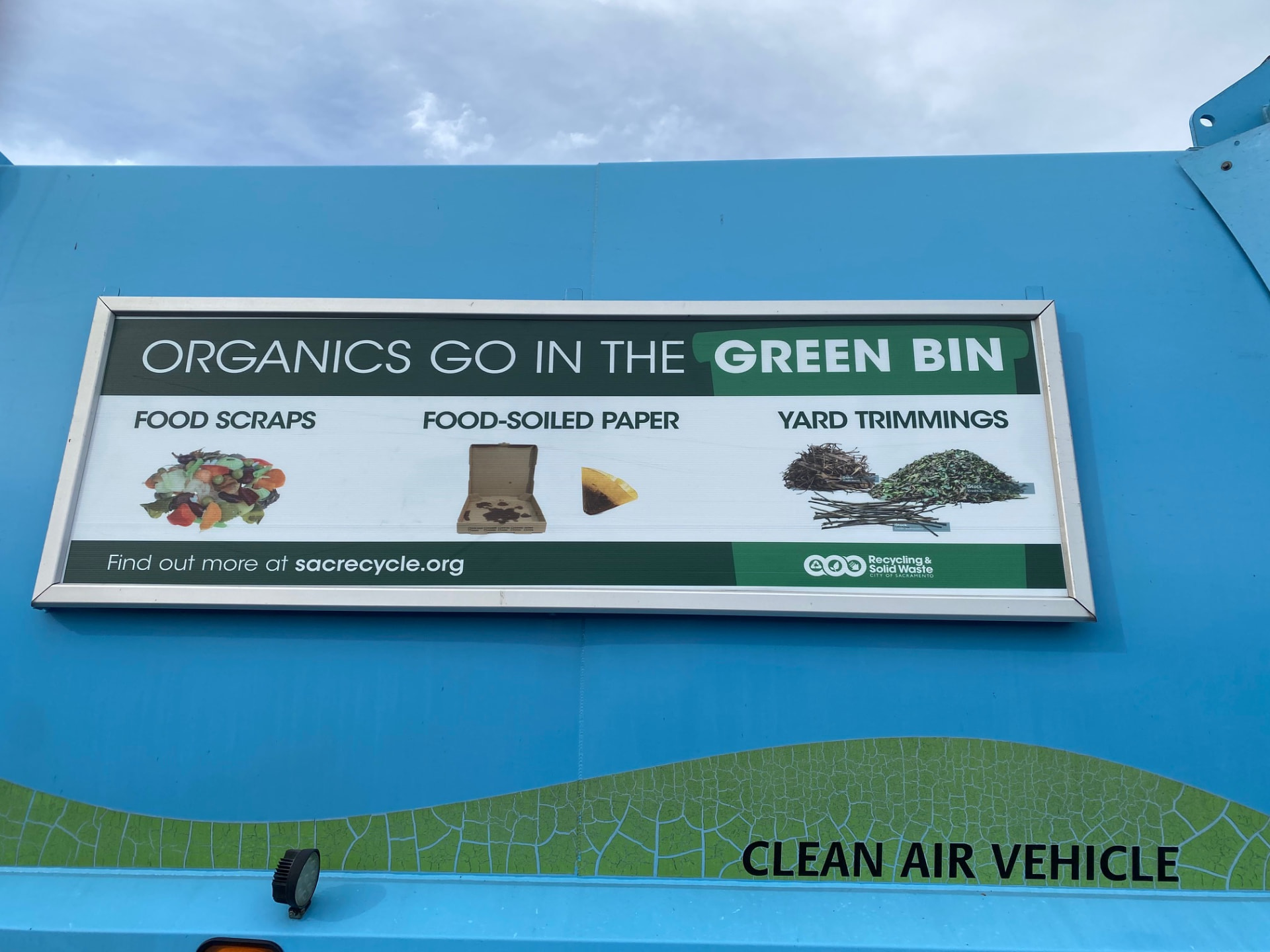
| Signs on the collection fleet | Seen on every route, every week, next to the cart | One short message at a time |
In California, SB 1383 sets a baseline for organics outreach. Each jurisdiction must give organic waste generators education information every year, may deliver it through print or electronic media, and may add workshops, meetings or on-site visits. The materials must also be translated into any non-English language spoken by a substantial number of the residents served (14 CCR § 18985.1).
The question of where the message goes is an old one. Dennis Barrett, who designed the first frames with his father Bob in 1987, recalls what cities had then: "cities and municipalities did not know how to promote and educate the public on recycling especially with new State mandates. The only mediums they had were TV, newspaper, billboard, or mail inserts into the Bill."
How long should a campaign run?
Long enough for residents to see the message several times where they sort, and short enough that it still feels new. Many programs plan by season and set the year's calendar in advance, so each campaign has its artwork approved before it starts.
An early calendar also helps with the deadline that shows up anyway. Dennis describes it: "a few times a year I will get a phone call from one of my clients, when they have a deadline that is usually less than a week away."
How do you tell whether it worked?
Decide on the measure before launch, then check the same thing afterward. Route audits, cart-tag counts and facility reports are the usual sources, and they also point to the next item to target.
If nothing moved on the same routes, change the channel or the message before you change the goal.
California jurisdictions with three- or two-container organic waste collection are already required to gather this kind of data. SB 1383 has them either review every hauler route for prohibited contaminants each year or run waste evaluations at least twice a year, in two distinct seasons (14 CCR § 18984.5). Those reviews can double as a campaign's before-and-after check.
Where does the collection fleet fit?
The collection truck is the one part of a recycling program every household sees on its own street, next to its own cart. A campaign message on the side of that truck reaches residents on collection day, where the rule applies.
The catch is that recycling outreach changes with the season, and a truck has to carry whatever this quarter's campaign says. Roadway's Quick-Change Frame System handles that with hardware: an aluminum frame riveted to the truck once, holding a printed campaign panel by spring tension on all four sides. An authorized member of your crew changes the panel at the yard in under 30 seconds.
For a city planning its campaign calendar around the fleet:
- No minimum order. Equip one truck to test a message on one route, then add trucks.
- Free design with unlimited proof rounds, built to be read from a moving vehicle.
- Panels ship five to seven business days after proof approval, and a rush moves to the front of the line at no extra charge.
- The frame is warranted indefinitely against mechanical failure. Damage from trees, buildings and driving is excluded.
San Diego, Roadway's first customer, still runs the frames, and Burbank, Los Angeles (LA Sanitation), Sacramento, Long Beach, Pomona and Hanford have put Roadway panels on their collection trucks. See how cities plan a full calendar of community messaging on the same fleet, or how a hauler meets contract public-education duties.
Dennis puts the goal this way: "help cities, promote and educate the public on recycling."
If your next campaign could use the fleet, Get Budgetary Pricing Tell us your truck count, body types and the first message, and we will send figures your department can use for planning and grant applications, with a no-charge mockup of your own trucks wearing the artwork.
Frequently asked questions
What is the difference between recycling education and recycling outreach?
The terms are used almost interchangeably. Education usually means teaching the rules, and outreach means the channels and events that put those rules in front of residents.
How many messages should one campaign carry?
One. A single clear action is easier to remember at the curb, and it makes the result easier to measure.
Can a private hauler run recycling education on its trucks?
Yes. A hauler whose city contract includes public education can carry the campaign on its own vehicles; see frames for private haulers.
How often can a truck's campaign panel change?
As often as the program needs. The frame stays on the truck, and a crew member swaps the printed panel in under 30 seconds.
About the author. Dennis Barrett is President of Roadway Displays. He built the first frames with his father Bob in 1987, has worked at Roadway full time since June 2000, and runs manufacturing and printing in Temecula, California.